

The Syntakt User Manual details device compliance, safety, and troubleshooting, offering essential setup and operation guidance. It’s copyrighted 2024 by Elektron Music Machines.
What is the Elektron Syntakt?
The Elektron Syntakt is an advanced musical instrument, a powerful synthesizer detailed within its comprehensive user manual. This manual, copyrighted 2024 by Elektron Music Machines MAV AB, serves as a vital resource for both beginners and experienced users. It outlines the device’s capabilities, covering installation, operation, and troubleshooting.
The manual emphasizes FCC compliance and provides essential safety instructions. It’s designed to help users maximize their experience with the Syntakt, navigating its features and understanding its potential within a new musical epic.
Key Features and Capabilities
The Syntakt’s user manual highlights its diverse features, including analog and digital synthesis engines, and sampling capabilities. It details how to transfer samples and projects, and utilize Overbridge for expanded functionality. The manual emphasizes the device’s potential for creating unique sounds and complex sequences.
Furthermore, it covers essential aspects like parameter locks, effects, and modulation options. The manual serves as a guide to unlocking the Syntakt’s full creative power, ensuring users can explore its vast sonic landscape effectively.
Getting Started with Syntakt
The manual guides initial setup, OS installation, and Transfer usage. Download the Twinshot Sound Pack to begin sample playback and explore Syntakt’s potential.
Unboxing and Initial Setup
Upon receiving your Elektron Syntakt, carefully inspect the packaging for any signs of damage during transit. The manual emphasizes the importance of retaining the original packaging for potential future transport or warranty claims. Inside, you’ll find the Syntakt unit itself, a power adapter, and essential documentation – including this very user manual! Before powering on, ensure the correct voltage is selected on the power adapter. The manual provides clear diagrams illustrating the physical connections. Initial setup involves connecting the power adapter and, optionally, MIDI devices.
Installing the Operating System and Transfer
The Syntakt requires the latest operating system for optimal performance and access to all features. The manual directs users to Elektron’s website to download the OS, Transfer utility, and the complimentary Twinshot Sound Pack. The Transfer tool facilitates seamless sample and project data exchange between your computer and the Syntakt; Following the manual’s instructions, connect the Syntakt to your computer via USB. Run the Transfer application and follow the on-screen prompts to install the OS and transfer desired content.
Downloading the Twinshot Sound Pack
To quickly begin sample playback on your new Syntakt, Elektron provides the free Twinshot Sound Pack. This pack is readily available for download alongside the operating system and Transfer utility on the Elektron website. The manual guides users through the download process, ensuring a smooth installation. Utilizing the Transfer application, users can easily import the Twinshot samples directly to their Syntakt. This allows immediate exploration of the instrument’s sampling capabilities and provides a solid foundation for sound design.

Understanding the Syntakt Interface
The Syntakt manual outlines the physical layout, menu navigation, and display functions, providing essential knowledge for operating this advanced musical instrument effectively.
Overview of the Physical Layout
The Syntakt manual details the instrument’s physical design, crucial for understanding its operation. Users will find a comprehensive guide to the front panel controls, including knobs, buttons, and the performance pads. The manual illustrates the placement of input/output connections, vital for integrating Syntakt into your studio setup.
It also explains the rear panel features, such as MIDI ports and USB connectivity. A clear understanding of the physical layout, as presented in the manual, is fundamental to navigating Syntakt’s capabilities and maximizing its creative potential. The manual serves as a visual and functional roadmap.
Navigating the Menu System
The Syntakt manual provides a detailed walkthrough of its menu system, essential for accessing and modifying parameters. It explains how to use the control knobs and buttons to navigate through different menus and submenus. The manual clarifies the hierarchical structure, allowing users to efficiently locate specific settings.
Understanding the menu system, as outlined in the manual, unlocks the full potential of Syntakt’s sound design capabilities. It details how to save and recall settings, customize performance parameters, and manage projects. Mastering this navigation is key to a fluid workflow.
Understanding the Display
The Syntakt manual dedicates a section to fully explaining the functionality of the device’s display. It details how parameters, waveforms, and sequencing information are visually represented. Users learn to interpret the various icons and indicators, crucial for monitoring Syntakt’s operation.
The manual clarifies how the display interacts with the menu system, providing visual feedback during parameter adjustments. It also explains how to customize display settings for optimal visibility and workflow. A clear understanding of the display, as detailed in the manual, is vital for efficient operation.
Syntakt’s Sound Engines
The Syntakt manual thoroughly explores its analog, digital, and sampling capabilities, detailing how each engine functions and interacts for sound creation.
Analog Synthesis Engine
The Syntakt manual dedicates significant detail to its analog engine, explaining its core components and signal flow. Users will discover how to sculpt sounds utilizing oscillators, filters, and amplifiers, all within a distinctly Elektron workflow. The documentation clarifies parameter interactions, showcasing the engine’s potential for creating classic and evolving tones.
It guides users through understanding the nuances of each module, enabling precise control over sonic characteristics. The manual emphasizes techniques for achieving warmth, punch, and dynamic expression, vital for crafting compelling musical elements. It’s a comprehensive resource for mastering the analog heart of the Syntakt.
Digital Synthesis Engine
The Syntakt manual thoroughly explores the digital synthesis capabilities, detailing FM, wavetable, and granular methods. It explains how these techniques expand the sonic palette beyond traditional analog approaches. Users learn to manipulate algorithms, waveforms, and parameters to generate complex and innovative sounds.
The documentation provides clear explanations of each digital engine’s unique characteristics, empowering users to blend them with the analog components. Mastering the digital engine unlocks a vast range of textures and timbres, crucial for modern sound design and experimentation, as detailed within the manual.
Sampling Capabilities
The Syntakt manual dedicates significant attention to its sampling features, outlining how to import, manipulate, and utilize samples within the instrument. It details the process of transferring samples via USB and explains the available editing tools for shaping and processing imported audio.
Users will discover how to load the free Twinshot Sound Pack, a starting point for sample-based sound design. The manual clarifies sample length limitations and file format compatibility, ensuring a smooth workflow. Mastering sampling expands the Syntakt’s versatility, as thoroughly documented.

Sequencing and Pattern Creation
The Syntakt manual thoroughly explores the sequencer, detailing pattern creation, editing techniques, and the powerful functionality of parameter locks for dynamic control.
The Syntakt Sequencer: A Deep Dive
The Syntakt’s sequencer, as outlined in the manual, is a cornerstone of its creative potential. It moves beyond traditional step sequencing, offering a highly flexible and intuitive workflow. Users can craft complex rhythmic patterns and melodic phrases with ease, leveraging the device’s unique parameter locking capabilities.
The manual details how to utilize the sequencer’s various modes, including step recording, real-time input, and probabilistic triggers. Mastering these techniques unlocks a world of sonic possibilities, allowing for intricate and evolving compositions. The documentation emphasizes the importance of experimentation and encourages users to explore the sequencer’s full range of features.
Creating and Editing Patterns
The Syntakt manual thoroughly explains pattern creation and editing; Users begin by defining a pattern length and tempo, then inputting steps for each track. The manual details how to adjust pitch, velocity, and other parameters for each step, shaping the sonic character of the pattern.
Editing functions allow for step duplication, deletion, and transposition. The documentation highlights the use of the “Fill” and “Scale” modes for generating variations. Furthermore, the manual guides users through saving and loading patterns, facilitating efficient workflow and project organization.
Using the Parameter Locks
The Syntakt manual dedicates significant attention to Parameter Locks, a core sequencing feature. These allow users to record parameter changes on a per-step basis, creating dynamic and evolving sounds. The documentation details how to access and assign parameters to individual steps, offering granular control over modulation and timbre.
The manual explains how to utilize Parameter Locks for effects, filter cutoff, and other crucial sound-shaping elements. It also covers techniques for creating complex rhythmic variations and automating parameter changes within a single pattern, unlocking advanced sequencing possibilities.
Effects and Modulation
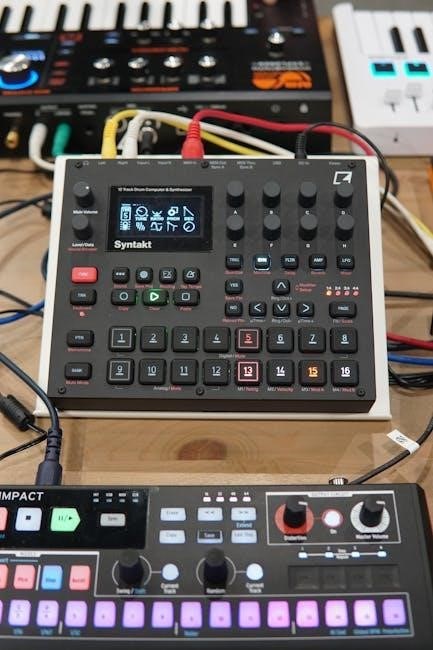
The Syntakt manual thoroughly explains built-in effects like delay and reverb, alongside LFOs, envelopes, and performance macros for extensive sound design.
Built-in Effects: Delay, Reverb, and More
The Elektron Syntakt manual comprehensively covers its integrated effects suite, going beyond simple delay and reverb options. Users will discover a diverse range of processing tools to sculpt and enhance their sounds. The manual details parameters for each effect, allowing for precise control over characteristics like feedback, diffusion, and modulation depth.
Explore creative possibilities with these effects, shaping textures and adding depth to your compositions. The documentation provides insights into how these effects interact with the Syntakt’s sound engines, offering a pathway to unique sonic landscapes. Mastering these effects is key to unlocking the full potential of the instrument.
LFOs and Envelopes
The Elektron Syntakt manual dedicates significant attention to Low Frequency Oscillators (LFOs) and envelopes, crucial for dynamic sound design. It explains how to assign LFOs to modulate various parameters, creating evolving textures and rhythmic movement. Detailed explanations cover waveform selection, rate control, and depth adjustments for nuanced modulation.
The manual also thoroughly describes the envelope generators, outlining their stages (attack, decay, sustain, release) and how they shape the amplitude and other characteristics of sounds. Understanding these tools, as detailed in the manual, is vital for expressive performance and intricate sound creation.
Performance Macros
The Elektron Syntakt manual highlights the power of Performance Macros for real-time control. These macros allow users to simultaneously modulate multiple parameters with a single knob or external controller, enabling expressive and dynamic performances. The manual details how to assign parameters to macros, adjust their ranges, and save macro settings as part of a performance.
It emphasizes the importance of strategic macro assignments for intuitive control during live sets. Mastering performance macros, as explained in the manual, unlocks the Syntakt’s full potential for improvisation and sonic manipulation.
Data Management and Transfer
The Syntakt manual explains transferring samples, projects, and utilizing Overbridge. Backup and restore functions are also detailed for secure data handling.
Transferring Samples and Projects
The Elektron Syntakt manual provides comprehensive instructions on transferring both samples and complete projects to and from the device. It details the necessary software – Elektron Transfer – for seamless file management. Users can efficiently load new sounds and back up their creations.
The manual clarifies the process of connecting the Syntakt to a computer, ensuring stable data transfer. It also outlines file format compatibility and best practices for organizing samples. Successfully transferring data allows for expanded sonic possibilities and project preservation, as described within the documentation.
Using Overbridge with Syntakt
The Elektron Syntakt manual thoroughly explains integration with Overbridge, Elektron’s powerful software suite. This connection unlocks advanced functionality, transforming the Syntakt into a VST/AU plugin within your Digital Audio Workstation (DAW).
The manual details installation procedures, troubleshooting common connectivity issues, and maximizing Overbridge’s capabilities. Users gain access to individual track outputs, detailed parameter control, and enhanced sample management. Downloading the latest Overbridge version, alongside the Syntakt OS, is recommended for optimal performance, as outlined in the documentation.
Backup and Restore Functions
The Elektron Syntakt manual emphasizes the importance of regular data backups to prevent project loss. It details procedures for creating complete system backups, encompassing projects, samples, and settings, utilizing Transfer.
The manual clearly outlines the restore process, guiding users through recovering their Syntakt to a previous state. This is crucial for safeguarding creative work against unforeseen errors or system failures. Following the manual’s instructions ensures a smooth and reliable backup and restore workflow, protecting valuable musical creations.
Troubleshooting Common Issues
The Syntakt manual provides guidance on resolving audio and MIDI connectivity problems, as well as addressing potential system errors for optimal performance.
Addressing Audio Problems
The Elektron Syntakt manual offers solutions for various audio concerns. First, verify all cable connections are secure and functioning correctly. Check the output volume levels on both the Syntakt and any connected amplification systems. If experiencing distortion, reduce the output gain or individual track volumes.
Ensure proper audio interface settings within the Overbridge application, if utilized. The manual details troubleshooting steps for no audio output, static, or unexpected noises. Consult the dedicated section for specific error codes and recommended fixes, ensuring a pristine sonic experience with your Syntakt.
Resolving MIDI Connectivity Issues
The Elektron Syntakt manual provides guidance for establishing stable MIDI connections. Begin by verifying the MIDI cable is securely connected to both the Syntakt and your controller or interface. Confirm the correct MIDI channel is selected on both devices for communication.
If using Overbridge, ensure the application recognizes the Syntakt as a MIDI device. The manual details troubleshooting steps for MIDI data not being received or transmitted. Check for conflicting MIDI devices and update drivers if necessary, ensuring seamless integration with your existing setup.
Dealing with System Errors
The Elektron Syntakt manual outlines procedures for addressing potential system errors. Should the device freeze or display an error message, a soft reset is often the first recommended step. This can usually be initiated through the menu system without data loss.
For more persistent issues, the manual details how to perform a factory reset, though this will erase user data. Regularly backing up projects, as described in the manual, is crucial. Contact Elektron support if errors persist after attempting these troubleshooting steps.
Safety and Maintenance
The Syntakt manual covers FCC compliance, cleaning instructions, and warranty details, ensuring safe operation and proper care of your Elektron Syntakt instrument.
FCC Compliance Information
The Elektron Syntakt has been tested and found to comply with the limits for a Class B digital device, per Part 15 of the FCC Rules. These limits are designed to provide reasonable protection against harmful interference in a residential installation.
This device generates, uses, and can radiate radio frequency energy. If not installed and used in accordance with the instructions, it may cause interference to radio communications. However, there is no guarantee that interference will not occur in a particular installation.
Any changes or modifications not expressly approved by Elektron could void the user’s authority to operate the equipment. The manual details these regulations for user awareness.
Cleaning and Care Instructions
To maintain your Elektron Syntakt in optimal condition, regular cleaning is recommended. Use a soft, dry cloth to wipe down the exterior surfaces. Avoid using liquid cleaners or abrasive materials, as these can damage the finish.
Do not attempt to disassemble the unit. This will void the warranty and could lead to malfunction. Keep the Syntakt away from excessive dust, moisture, and extreme temperatures. Proper care, as outlined in the manual, ensures longevity.
Store the device in a clean, dry environment when not in use.
Warranty Information
The Elektron Syntakt is covered by a limited warranty, protecting against defects in materials and workmanship. This warranty, detailed within the full Syntakt User Manual, specifies the duration and conditions of coverage. It’s crucial to register your product to activate warranty benefits.
The warranty does not cover damage resulting from misuse, accidents, or unauthorized modifications. Retain your proof of purchase for warranty claims. Refer to the manual for complete warranty details and service procedures.

Legal Disclaimers and Copyright
The Syntakt User Manual is copyrighted 2024 by Elektron Music Machines; reproduction is prohibited without authorization. Information is subject to change without notice.
Copyright Notice
This Syntakt User Manual, a comprehensive guide to the Elektron Syntakt synthesizer, is protected by copyright laws. It is owned by Elektron Music Machines MAV AB, established in 2024. All rights are explicitly reserved.
No portion of this manual, whether digital or printed, may be reproduced, distributed, or transmitted in any form or by any means without prior written consent from Elektron. This includes, but isn’t limited to, photocopying, recording, or any information storage and retrieval system.
Unauthorized use constitutes a violation of copyright law and may result in legal consequences. Elektron retains the exclusive right to modify and update this manual as needed.
Elektron Music Machines provides this Syntakt User Manual as a guide for operating the synthesizer. While every effort has been made to ensure accuracy, Elektron assumes no liability for errors or omissions contained within. Information is subject to change without notice.
Elektron is not responsible for any damages, direct or indirect, arising from the use or misuse of the Syntakt or reliance on the information presented in this manual. Users assume full responsibility for their actions and understanding of the device.
This disclaimer extends to potential system errors or unexpected behavior.
Terms of Use
Accessing the Elektron Syntakt User Manual signifies agreement to these terms. This manual is for personal, non-commercial use only. Reproduction, digital or printed, without explicit written authorization from Elektron Music Machines MAV AB is strictly prohibited, as it’s copyrighted 2024.
Elektron reserves the right to modify the manual’s content without prior notification. Users are responsible for reviewing updates. Any unauthorized distribution or alteration of this document is a violation of these terms.
Use of this manual implies acceptance of these conditions.

Resources and Support
Explore Elektron’s official website, community forums, and GitHub for Syntakt resources, user groups, and development contributions – enhancing your experience.
Elektron’s Official Website
The Elektron Music Machines website serves as the primary hub for all Syntakt-related information. Here, users can access the latest official documentation, including the comprehensive Syntakt User Manual in downloadable PDF format. Beyond the manual, the site provides firmware updates to ensure optimal performance and access to new features.
Furthermore, Elektron’s website features a dedicated support section, offering troubleshooting guides, FAQs, and contact information for direct assistance. Customers can also find details regarding warranty information, FCC compliance, and other essential legal disclaimers pertaining to the Syntakt. Explore customer stories, events, webinars, and business insights too!
Community Forums and User Groups
Engage with fellow Syntakt owners through vibrant online community forums! These platforms offer a space to ask questions, share tips, and troubleshoot issues related to the Syntakt and its manual. Users frequently contribute insights, custom patches, and creative workflows, expanding the learning experience beyond the official documentation.
Discover user-created tutorials, sample packs, and collaborative projects. These groups provide invaluable peer-to-peer support, fostering a collaborative environment where Syntakt enthusiasts can connect, learn, and inspire each other, supplementing the official Elektron resources.
GitHub Resources for Syntakt
Explore the Elektron Syntakt ecosystem on GitHub, a hub for developer contributions and community-driven projects. Find resources like custom scripts, tools, and potentially even modifications enhancing the Syntakt’s functionality. The vilaca/synth-manuals development project offers a curated collection of synthesizer manuals, including potentially helpful Syntakt-related materials.
GitHub serves as a platform for advanced users to share their expertise and contribute to the Syntakt’s open-source potential, offering deeper insights beyond the official user manual and fostering innovation within the community.